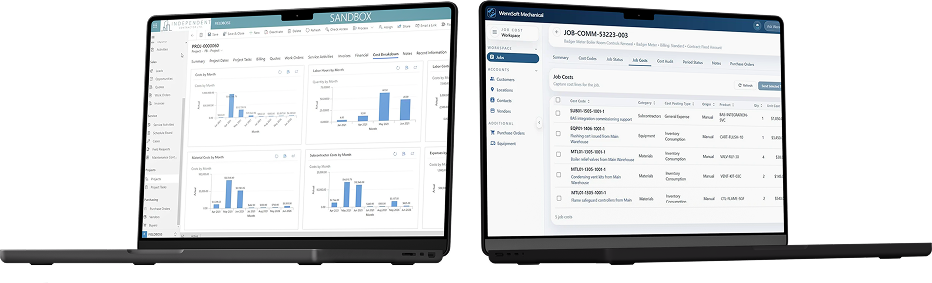
At a Glance
|
Capability |
WennSoft |
FIELDBOSS |
|---|---|---|
|
Primary industries served |
HVACR, mechanical, fire/security, specialty trades |
HVAC and elevator / vertical transportation |
|
Product lineup |
Three lines depending on platform stage: Signature (Dynamics GP), FORGE (Azure, connected to BC), Nexus (design-partner only) |
One product, one architecture |
|
Underlying platform |
Dynamics GP (Signature) or Microsoft Azure (FORGE) |
Microsoft Dynamics 365 Sales, Service, & Business Central |
|
How field service connects to the ERP |
Separate application connected to GP or BC |
Native extension inside Business Central — same data model |
|
Microsoft platform support status |
GP mainstream support ends Dec 31, 2029; security patches end Apr 30, 2031 |
Business Central is Microsoft’s current, actively developed ERP |
|
Field-to-finance flow |
Requires integration between the field service app and the ERP |
Technician closes job → flows directly into job costing, billing, payroll |
|
Refrigerant / EPA compliance tracking |
Not stated as a vendor capability |
Native to the service workflow |
|
Elevator inspection & compliance workflows |
Not a stated target industry |
Native — ties every unit to its contract and service history |
|
AI / predictive maintenance |
“Wennston” AI assistant in FORGE only, for setup and planning guidance |
AI assists with time approval and job markup and approval |
|
Construction-style job costing (retention, forecasting, change orders) |
Deeper construction-project depth than FIELDBOSS targets |
Full project management with progress billing |
|
Implementation model |
Varies by product line and existing GP customization depth |
Single implementation path onto Business Central |
|
Migration exposure |
GP customers face a platform decision on Microsoft’s timeline regardless of what they choose today |
None — already on Microsoft’s current stack |
Source: WennSoft’s own site (Signature, FORGE, and AHR 2026 pages), Microsoft’s published Dynamics GP lifecycle policy, Software Advice reviews, and FIELDBOSS implementation experience. Full methodology below in “How This Comparison Was Prepared.”
Who Each Is Built For
WennSoft
- Target ICP: commercial HVACR, mechanical, fire/security, and specialty trade contractors — WennSoft does not name elevator or vertical transportation as a target industry.
- Core strength (as stated by vendor): three decades of job-costing and field-service depth built on Microsoft partnership, with construction-style project features — retention, forecasting, change orders — that go deeper than most HVAC-only tools.
- Operating model: assumes the contractor is running, or actively moving to, a Microsoft ERP — historically Dynamics GP, now also Business Central via FORGE — with WennSoft’s field service layer connected to it rather than built inside it.
FIELDBOSS
- Target ICP: commercial HVAC and elevator/vertical-transportation contractors, from growing independents to multi-entity, PE-backed portfolios.
- Core strength: purpose-built for HVAC and elevator maintenance-contract economics — refrigerant and EPA compliance, equipment-level service history, elevator inspection tracking — running natively inside Business Central.
- Operating model: a single Microsoft ERP instance where field operations and financials share the same data model from day one.
How the Platforms Differ
Short answer: FIELDBOSS is built as a native extension inside Dynamics 365 Sales, Service and Business Central; WennSoft’s three product lines are all separate applications connected to an ERP.
Signature runs as a job-costing and field-service layer integrated into Dynamics GP’s accounting. FORGE, WennSoft’s newer offering, is described by WennSoft itself as “built on Microsoft Azure” and “connected to Dynamics 365 Business Central” — a separate cloud application talking to BC, not built inside it. Nexus, announced at AHR 2026, is currently a limited design-partner program with deployments planned for 2026 — not a shipping product a contractor can buy today. FIELDBOSS, by contrast, is a Business Central extension: field operations and financials are one data model from the first day of implementation, with no second application to keep in sync.
Short answer: FIELDBOSS closes a work order directly into job costing, billing, and payroll; WennSoft’s architecture requires an integration between the field service application and the ERP.
Because Signature and FORGE both sit alongside GP or Business Central rather than inside them, data has to move between systems — through an integration layer that has to be built, tested, and maintained. When a FIELDBOSS technician closes a job, it flows directly into job costing, billing, and payroll inside the same Dynamics 365 instance. No re-entry, no reconciliation gap, no after-the-fact sync to troubleshoot when something doesn’t match.
Short answer: refrigerant tracking, EPA compliance, and elevator inspection workflows are native to FIELDBOSS; WennSoft doesn’t market equivalent industry-specific compliance capability.
WennSoft’s own materials describe general service management, job costing, and equipment tracking — useful across HVACR, mechanical, fire/security, and specialty trades, but with no stated refrigerant/EPA compliance workflow or elevator inspection capability, because elevator isn’t a market WennSoft targets. FIELDBOSS ties every HVAC unit and every elevator to its contract and full service history, with compliance documentation completed as part of the work order rather than assembled afterward for an auditor.
Short answer: FIELDBOSS customers are already on Microsoft’s current ERP; existing WennSoft Signature customers are not, and Microsoft has published the date that changes.
Microsoft’s current published lifecycle has Dynamics GP mainstream support ending December 31, 2029, with security patches continuing on a limited basis through April 30, 2031. WennSoft has said it will keep enhancing Signature on GP through that window, and is separately building FORGE and Nexus as paths forward — but a contractor evaluating WennSoft today is choosing among three products at three different levels of maturity, one of which (Nexus) isn’t generally available yet. A contractor on FIELDBOSS today isn’t choosing among future options; they’re already on the platform Microsoft is actively developing.
Where WennSoft May Be the Better Fit
WennSoft is likely the stronger choice if:
- You’re a commercial HVACR or mechanical contractor deeply invested in Dynamics GP customizations — payroll, union reporting, other GP-native modules — and aren’t ready to replatform inside the current support window.
- You’re a specialty trades or fire/security contractor whose work mixes field service with true construction-style projects, where retention, forecasting, and change-order management matter as much as service dispatch.
- You want to be an early design partner on Nexus and are comfortable trading platform maturity for roadmap influence.
- Your priority for the next two to three years is minimizing disruption, with the understanding that the platform question gets revisited once Nexus or FORGE has a real track record.
These are real scenarios. If they describe you, the rest of this page is less relevant to your situation — and that’s the honest answer.
Migrating from WennSoft to FIELDBOSS
|
Field |
What to expect |
|---|---|
|
What data typically migrates |
Customers, equipment/asset records, service and maintenance history, open work orders, contract terms. GP financial history is its own workstream. |
|
Typical implementation duration |
5–6 months end to end — data, retraining, parallel run, go-live — for a full Signature-to-FIELDBOSS migration. |
|
What training looks like |
Field technicians (mobile app), dispatchers and schedulers, and finance/back office all train — the job-to-invoice flow changes structurally, not just at the field-admin level. |
|
What gets re-thought |
Chart of accounts and financial dimensions move from GP’s structure into Business Central’s. Any custom integrations built to connect Signature to GP are retired rather than replaced one-for-one. |
|
What stays the same |
Microsoft muscle memory — Excel-like grids, Outlook and Office integration — which reduces some retraining relative to leaving the Microsoft ecosystem entirely. |
Pricing and Total Cost of Ownership
WennSoft TCO components
- Dynamics GP or Business Central license (the underlying ERP)
- Signature or FORGE license (the field-service application layer)
- Integration and maintenance overhead connecting that application to the ERP, since neither runs inside it
- For Signature customers: an eventual migration project that isn’t optional, only a matter of timing
FIELDBOSS TCO components
- Dynamics 365 Business Central (financials, per user)
- Dynamics 365 Sale and Service (per user)
- The FIELDBOSS extension — no separate application to integrate or maintain
Frequently Asked Questions
FIELDBOSS is purpose-built for HVAC and elevator contractors, not a generic field service tool with vertical add-ons. Maintenance-contract billing, refrigerant/EPA compliance, and elevator inspection tracking are native to how the platform works, running inside Microsoft Dynamics 365 Business Central.
WennSoft’s Signature and FORGE products connect to Dynamics GP or Business Central through integration rather than running inside them, which means field and financial data pass between two systems. FIELDBOSS runs as an extension inside Business Central itself, so a closed work order updates job costing, billing, and payroll in the same instance — no sync step, no reconciliation gap.
WennSoft’s AI assistant, Wennston, is available in its newer FORGE product for setup and planning guidance; it isn’t part of Signature on Dynamics GP. FIELDBOSS uses AI to prepare technician briefings, approve time and job markups and invoicing.
Neither vendor publishes list pricing. WennSoft’s cost also depends on which product line you’re on — Signature, FORGE, or the early-access Nexus — each with a different license and maturity profile. FIELDBOSS pricing reflects one architecture: Business Central, Dynamics 365 Field Service, and the FIELDBOSS extension, with no separate integration layer to price in.
Yes. FIELDBOSS is built for any commercial HVAC or elevator contractor that needs accurate maintenance-contract billing and real job-cost visibility, independent of ownership structure. The multi-entity capability matters more as you grow, but the core platform serves single-entity contractors just as directly.
A full migration typically runs 5–6 months, covering data migration, parallel running, and staff training across field, dispatch, and finance teams. The scope depends on how deeply your current Signature instance is customized on Dynamics GP — more customization generally means more to re-map, not more risk in the outcome.
This comparison was prepared using publicly available vendor documentation from WennSoft and FIELDBOSS, Microsoft’s published Dynamics GP lifecycle policy, third-party reviews on Software Advice, and FIELDBOSS implementation experience with contractors who evaluated both platforms.
Third-party product capabilities change; this page was last reviewed July 2026. If a WennSoft capability is mischaracterized here, let us know at [monitored correction inbox — confirm real address and 5-business-day SLA before publish] and we will review it within 5 business days.
Book a Tailored Demo
This comparison was prepared using publicly available vendor documentation from WennSoft and FIELDBOSS, Microsoft’s published.